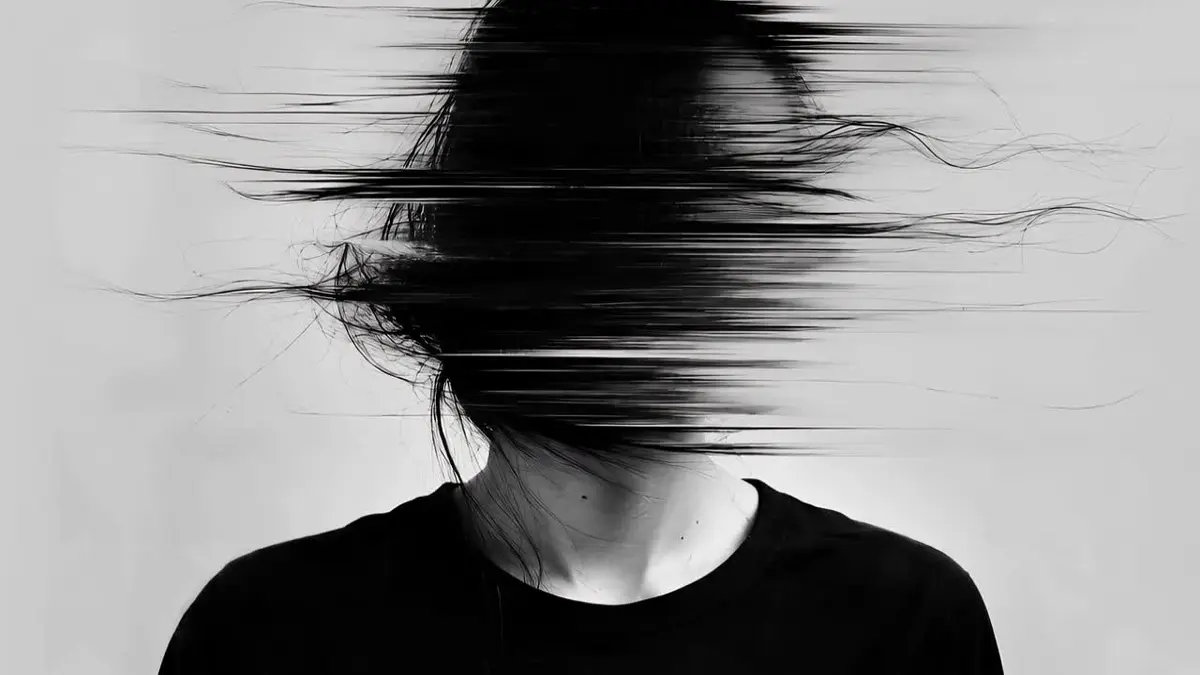
Digital Signal Loss.
· BMX AI · 10s · 720p
Scene & Mood: Digital Signal Loss. A surreal monochrome studio portrait where the person appears trapped inside a failing visual transmission. The mood is quiet, tense, anonymous, and psychological, with the black facial smears behaving like unstable signal interference rather than decorative paint. Frame Map: Centered medium portrait, shoulders visible across the lower third, head and neck in the center vertical axis. The figure stands in the front depth layer, close to camera, with a pale empty studio background filling the rear depth layer. Keep generous negative space around the head. The face area remains hidden behind horizontal black distortion bands spanning left to right across the upper head, eyes, nose, and mouth. Eyeline is implied forward but never clearly visible. Subject distance stays constant as a tight upper-body portrait. Subject Lock — @image1: Preserve the same anonymous upper-body figure from @image1: black shirt, pale neck, loose dark hair strands, centered silhouette, still pose energy, and face fully obscured by horizontal black smear distortion. @image1 keeps the same face, hair, wardrobe, body shape, and silhouette throughout. Do not invent visible facial features. Any partial reveal should be only fleeting skin edge, cheek contour, or neck shadow, never a readable identity. Cross-Frame Rules: Keep the figure centered and upright for the full 10 seconds. Do not swap screen position, do not change wardrobe, do not change body proportions, do not reveal the full face, and do not turn the portrait into a different person. The black horizontal interference stays anchored to the face and head region, never becoming floating text or graphic overlays. Maintain the same monochrome palette, pale background, black shirt, soft studio contrast, and anonymous identity. Movement: 10-second continuous shot. The body remains almost still, with only faint breath at the collar and a barely perceptible lift of the shoulders. Micro-motion: loose hair strands tremble slightly, the neck muscles make tiny natural shifts, the black shirt fabric subtly settles with breathing. The distortion bands jitter sideways in uneven pulses, stretching left and right like corrupted scanlines, thinning for a fraction of a second, then tearing into dense charcoal streaks again. Small gaps briefly expose soft skin edges beneath the interference, but the eyes and mouth never become readable. Environmental motion is minimal: pale background flickers gently like a weak signal passing through air, with fine grain and faint analog noise. Camera motion is a slow, almost imperceptible push-in from medium portrait to slightly tighter portrait over the full 10 seconds, with no sudden zooms. Last Frame: At exactly 10 seconds, the camera lands on a slightly tighter centered portrait. The figure is still, shoulders low, head facing forward, face completely swallowed by one dense black horizontal blackout band with thinner broken lines feathering outward into the pale background. The final image holds for a beat, locked and silent in expression, as if the signal has failed permanently. No on-screen text, no captions, no signage typography, no rendered text in the frame. World Plate: Minimal monochrome studio plate with a pale matte background, soft frontal light, gentle falloff around the neck and shoulders, and no visible props. The space feels empty and airless but physically real. Background texture is smooth paper or plaster, not pure digital white. Keep lifted shadows, soft highlight rolloff, subtle surface grain, and slight air depth around hair strands and distortion edges. Sound Bed: Low room tone, faint electrical hum, soft static crackle, tiny cloth movement from breathing, and a dry intermittent signal tick synced loosely with the horizontal distortion pulses. No music, no lyrics, no soundtrack, no score. Capture Realism: Natural skin texture where the neck and small skin edges are visible, matte fabric on the black shirt, realistic hair flyaways, soft highlight rolloff, lifted shadows, fine monochrome grain, restrained contrast, no plastic AI gloss, no wax skin, no over-sharp rendering, no crushed blacks, no clipped whites. The distortion should feel like filmed charcoal interference and analog signal failure integrated into the portrait, not a shiny digital effect. Camera Capture: 50mm lens, locked tripod with a nearly invisible slow push-in, 24fps, 180-degree shutter, wide-latitude cinema capture, monochrome editorial grade, fine 35mm grain, soft background falloff, realistic exposure, subtle analog flicker, 10 seconds runtime.